

Three current Chemyx syringe pumps can infuse, withdraw, and run programmed protocols: the Fusion 200X, the Fusion 4000X, and the Fusion 6000X. The Fusion 200X drives two syringes together and supports up to 99 program steps and 99 loops. The Fusion 4000X has two independent channels, so each syringe can run at its own rate and direction. The Fusion 6000X adds up to 700 lb of linear force for viscous, high-pressure work. The Fusion 100X is infusion only.
The right choice depends on three things: whether your method needs withdrawal, how complex the program is, and whether your two syringes can move together or need to move independently.
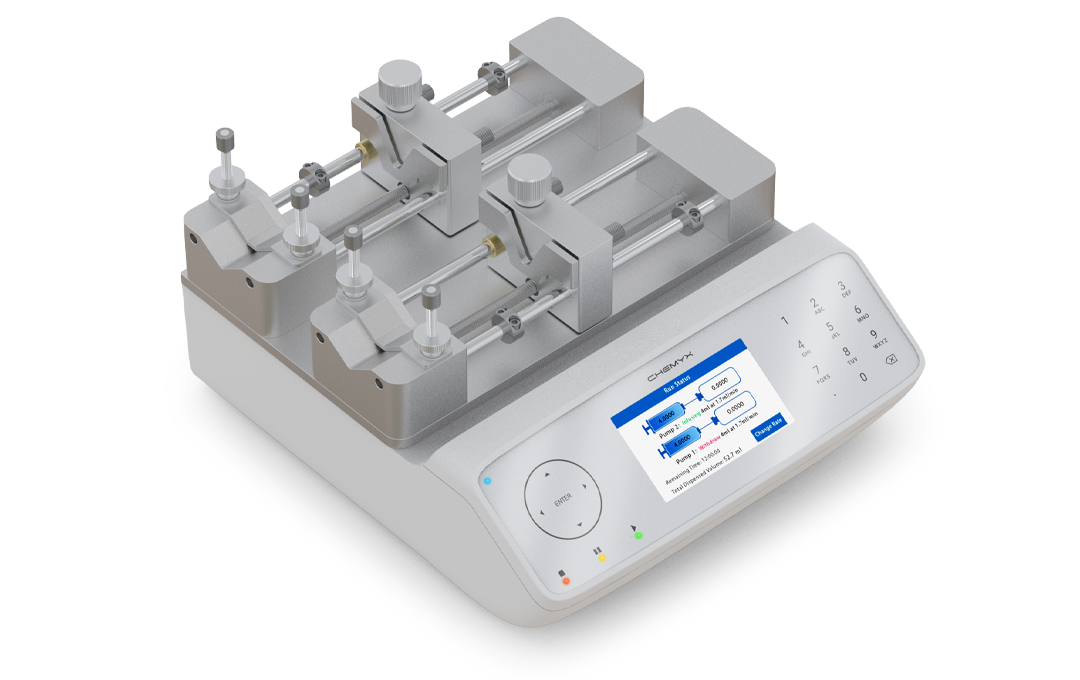
Chemyx Infuse/Withdraw Programmable Syringe Pumps Compared
All figures below come from the Chemyx product pages and spec sheets for each model [1] [2] [3].
| Feature | Fusion 200X | Fusion 4000X | Fusion 6000X |
|---|---|---|---|
| Direction | Infuse and withdraw | Infuse and withdraw | Infuse and withdraw |
| Channels | Two syringes on one drive | Two independent pump drives | One drive |
| Programming | Multi-step mode, up to 99 steps and 99 loops | Multi-step mode plus cycle (push-pull) mode | Programmable variable-rate profiles |
| Syringe size | 0.5 µL to 60 mL | 0.5 µL to 100 mL | Stainless steel syringes up to 300 mL |
| Max flow rate | About 85 mL/min | 170.5 mL/min (100 mL syringe) | 408 mL/min (300 mL syringe) |
| Min flow rate | 0.0001 µL/min (0.5 µL syringe) | 0.0001 µL/min (0.5 µL syringe) | 0.0001 µL/min (0.5 µL syringe) |
| Accuracy | ± < 0.35% | ± < 0.35% | ± < 0.35% |
| Expansion | 4- or 11-syringe push/pull racks | 2-syringe push/pull rack (up to 4 syringes) | 4-syringe rack (force is split across syringes) |
| Control | 4.3″ touchscreen, USB-B, RS232, TTL | 4.3″ touchscreen, USB-B, RS232, RS485, TTL | 4.3″ touchscreen, USB-B, RS232, TTL |
| Best for | Parallel syringes on the same multi-step program | Different rates, directions, or start times per syringe | Viscous fluids and dosing against back pressure |
All three pumps include the free programmable mode, a 2-year limited warranty, and computer control through ASCII commands, with SDK support for LabVIEW, LabWindows, Python, and MATLAB.
What Infuse, Withdraw, and Programmed Protocols Mean
These three terms describe different things, and spec sheets don’t always separate them clearly. Checking each one on its own will save you from buying the wrong pump.
Infuse and Withdraw
Infuse mode pushes the syringe plunger forward to dispense liquid. Withdraw mode pulls the plunger back to draw liquid into the syringe. Withdrawal only works when the plunger is clamped to the pusher block, so the pump can pull it as well as push it. The Fusion 200X ships with both infusion and withdrawal racks for this reason, while the Fusion 100X is designed for infusion only.
The fluid path matters too. A withdrawal command only draws liquid if your tubing, valves, fittings, and source container allow flow in that direction.
Programmed Protocols
A programmed protocol is a sequence of steps, each with its own rate, volume, or direction. Multi-step programming lets you ramp a flow rate, dispense at one rate and withdraw at another, or repeat a dosing cycle without touching the pump between steps.
Protocol limits differ by model. The Fusion 200X spec sheet lists up to 99 program steps and up to 99 loops, with the option to set each step by time or by rate. Always check the limits for the exact model you plan to buy rather than assuming every pump in a product family works the same way.
Two-Channel vs. Independent Channels
A two-channel pump holds two syringes. That does not mean each syringe has its own motor. On a shared drive, both syringes move together at the same rate and direction. On an independent design, each channel has its own drive and can run its own rate, direction, and start time.
Among current Chemyx pumps, the Fusion 4000X is the model with two independent pump drives. The Fusion 200X runs two syringes together, and the Fusion 6000X has a single pusher block.
Fusion 200X: Programmable Infuse/Withdraw for Parallel Syringes
The Fusion 200X is the right fit when your syringes should all follow the same program. It infuses and withdraws at pulseless, reproducible rates using a microstepper motor, and its multi-step mode handles complex flow profiles with up to 99 steps and 99 loops.
It holds syringes from 0.5 µL to 60 mL, with rates from 0.0001 µL/min up to about 85 mL/min. If you need more syringes on the same program, the 4-syringe rack or 11-syringe infuse/withdraw rack expands the pump without changing your method.
You can program the 200X on its touchscreen or from a computer over USB, RS232, or TTL. Chemyx has a step-by-step guide for setting up Python control on the Fusion 200X.
Common uses include microfluidics, organ and tissue perfusion, electrospinning, aerosols, pharmaceutical work, and reactor injections.

Fusion 4000X: Two Independent Infuse/Withdraw Channels
Choose the Fusion 4000X when two syringes need to do different things. It has two separate pump drives, so each channel can run its own rate, direction, and volume. You can start one channel on its own or start both together.
That independence opens up methods a shared drive can’t handle:
-
Different rates: deliver a saline and drug combination, or add a catalyst and co-catalyst to a reactor, each at its own rate.
-
Different syringe sizes: pair a small syringe with a large one in the same setup.
-
Push-pull cycling: in cycle mode, one channel infuses while the other withdraws, then they swap roles.
-
Staggered starts: begin one channel before the other within a single run.
The 4000X holds syringes from 0.5 µL to 100 mL and reaches up to 170.5 mL/min with a 100 mL syringe. Its reproducibility is listed at ± < 0.05%. It adds RS485 to the usual USB-B, RS232, and TTL ports, which lets you connect pumps in series. It’s widely used for lipid nanoparticle formulation, microfluidic mixing, and lab-on-chip flow control.
One point to know before ordering: the optional 2-syringe infuse/withdraw rack raises capacity to four syringes, but it does not add channels. You still have two independent pumps.
Fusion 6000X: Infuse and Withdraw Against High Pressure
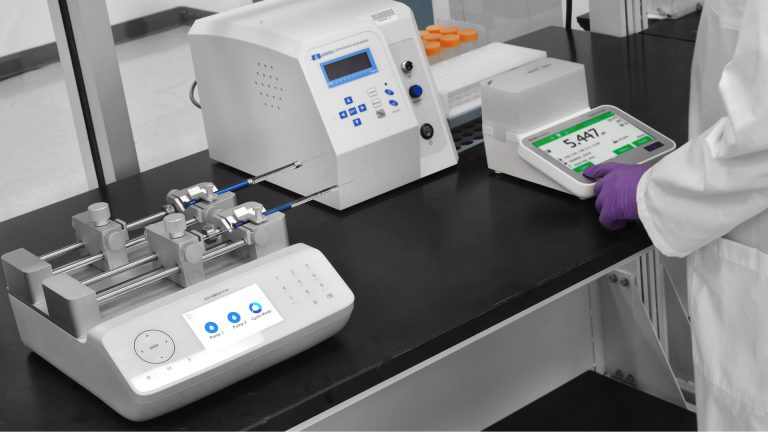
If your fluid is viscous or your method pushes against back pressure, look at the Fusion 6000X. It runs in infuse and withdraw mode with up to 700 lb of linear force, handles viscosities up to 250,000 cP, and supports programmable variable-rate profiles.
Maximum pressure depends on syringe size, viscosity, and tubing length. Chemyx lists a theoretical maximum of 4,000 psi with a 6 mL syringe, falling to 150 psi with a 300 mL syringe. Optional add-ons include a syringe heating sleeve up to 80°C and a pressure sensor that can hold a user-defined pressure during infusion.
The 6000X is a single-channel pump. A 4-syringe rack increases capacity, but the pushing force is divided across the syringes. Use stainless steel or plastic syringes, since glass can crack under this much force. For a side-by-side look at the two Fusion flagships, see the difference between the Fusion 4000X and Fusion 6000X.
What About the Fusion 100X and the Original Fusion 200?
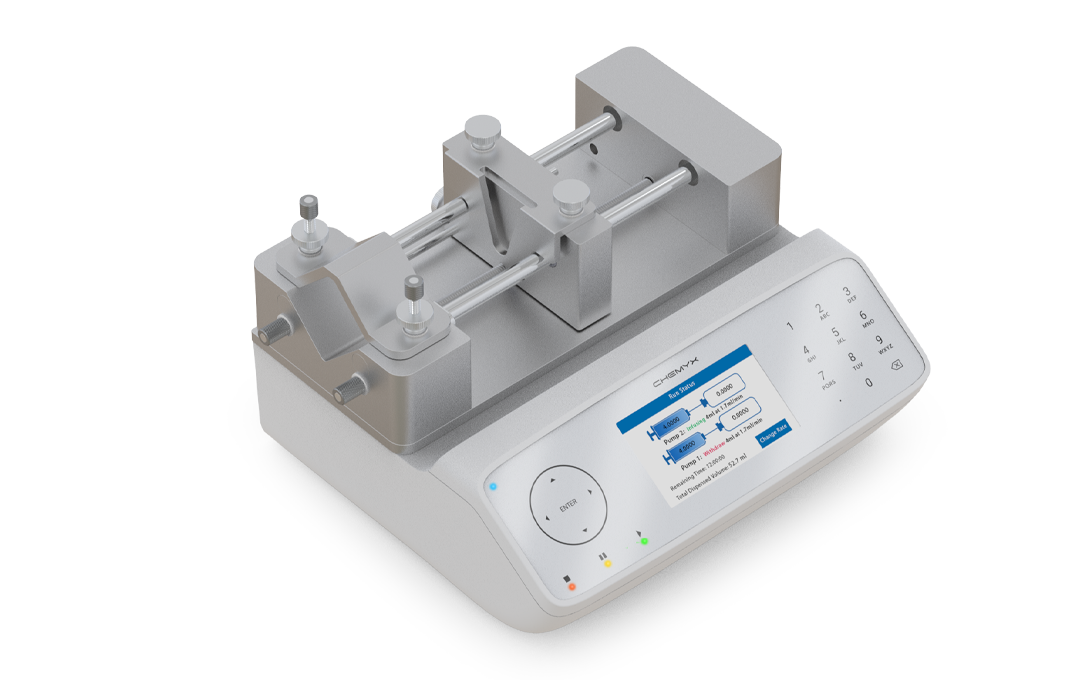
The Fusion 100X is a two-channel pump designed for infusion only. Chemyx states that its other specifications match the Fusion 200X, so it’s a good fit for dispensing-only methods, but not for anything that needs withdrawal.
The original Fusion 200 and Fusion 4000 are legacy products. The Fusion 200X replaced the Fusion 200, and the Fusion 4000X replaced the Fusion 4000. If you’re working from an older protocol or manual, check its specs against the current model before you transfer step counts or rates.
How to Choose the Right Infuse/Withdraw Syringe Pump
Define your method first, then match it to a model. Work through these questions:
-
Do you need withdrawal? If not, the Fusion 100X may be enough. If yes, choose the 200X, 4000X, or 6000X.
-
Should the syringes move together? If every syringe follows the same program, the Fusion 200X fits, and its racks scale to 11 syringes.
-
Do two syringes need different rates, directions, or start times? Choose the Fusion 4000X.
-
Is the fluid viscous or under back pressure? Choose the Fusion 6000X, or a high-pressure syringe pump for higher pressures.
-
What syringe size and flow range do you need? Check the syringe library for minimum and maximum flow rates.
-
Will you run it from a computer? See the available computer control programs for each model.
Setting Up a Bidirectional Run
Before you start a method that switches direction, run through a few checks:
-
Retention: make sure both the syringe barrel and the plunger are clamped, so the plunger can’t slip when the pusher block reverses.
-
Syringe definition: select the correct brand and size from the pump’s syringe database, or enter the inner diameter manually, so volumes and rates are accurate.
-
Fluid path: confirm tubing, valves, and fittings allow flow in both directions without drawing in air.
-
Syringe material: Chemyx pumps accept plastic, glass, and stainless steel syringes. Check the syringe type chart for your fluid.
If a withdrawal step stalls or delivers the wrong volume, the Chemyx syringe pump troubleshooting guides are a good place to start.
Continuous Flow and OEM Options
Infuse/withdraw capability is not the same as continuous flow. A continuous-flow system uses at least two syringes and switching valves, so one syringe delivers while the other refills. For uninterrupted delivery at high pressure, the HP6-CF continuous flow syringe pump pairs two HP6 pumps with a synchronized valve set.
If you’re building an instrument, the Fusion 4000X OEM offers dual independent channels as a bolt-on module, and the Fusion 6000X OEM covers high-pressure work.
Get Help Choosing an Infuse/Withdraw Syringe Pump
Send Chemyx your method, including direction changes, syringe sizes, flow rates, and how your syringes need to move, and our engineers will help you choose between the Fusion 200X, Fusion 4000X, and Fusion 6000X.
Request a Fusion 200X quote, request a Fusion 4000X quote, request a Fusion 6000X quote, or explore the full range of Chemyx syringe pumps. For help with a specific application, contact the Chemyx engineering team.