

What is a high-pressure syringe pump? A high-pressure syringe pump drives a piston at a precisely controlled speed with enough force to meter fluid against heavy backpressure, dense fluids and liquefied gases. It keeps the smooth, pulse-free flow of a laboratory syringe pump at pressures where most pumps lose precision. Choosing one starts with three numbers: the pressure you must push against, the flow rate you need, and the volume you must deliver before a refill.
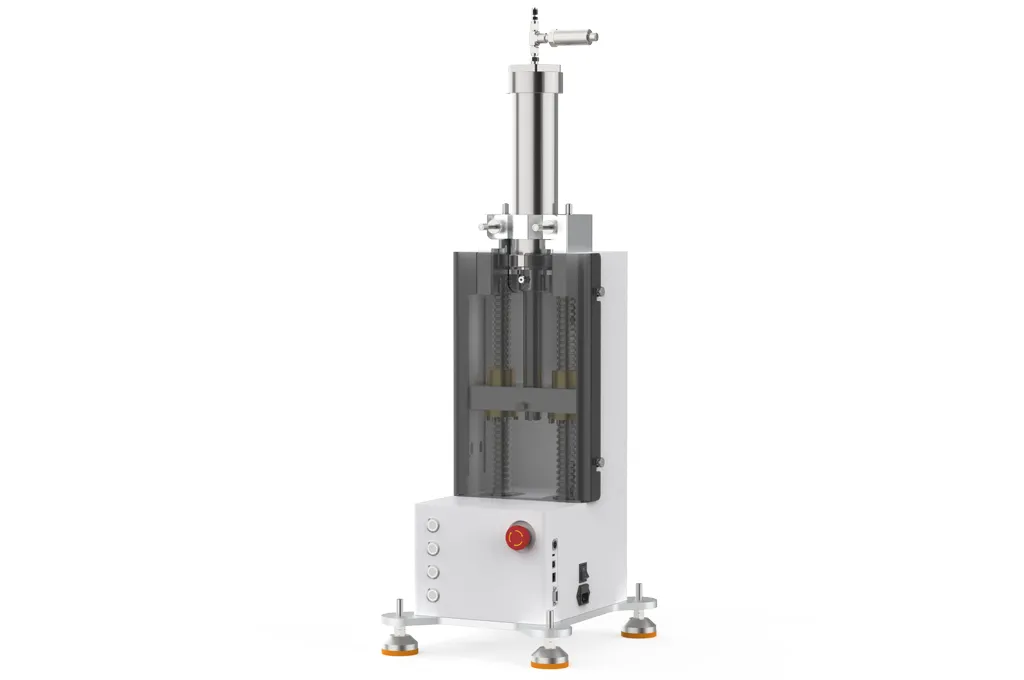
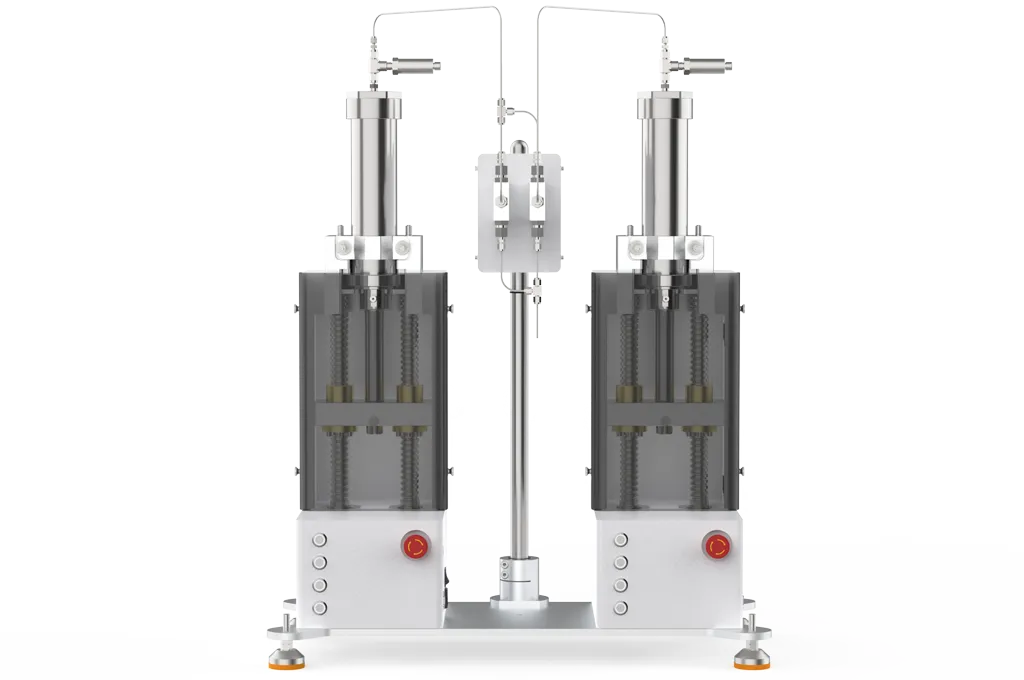
For researchers and engineers working at extreme pressures, Chemyx Inc. offers the HP6 Ultra High-Pressure Syringe Pump, with 6 to 10 tons of pushing force and pressures up to 2,124 bar, and the HP6-CF, which pairs two HP6 pumps for continuous, pulse-free flow.
How to Choose a High-Pressure Syringe Pump
Pressure, flow rate and volume per run decide the pump class. Heating, chemistry and control needs then narrow the choice. Use the table below to match your requirement to a Chemyx system.
| If your process needs… | Choose | Why |
|---|---|---|
| Pressure up to 2,124 bar, or up to 1 L per fill | HP6 | 6 to 10 tons of force and swappable cylinders from 90 mL to 1 L |
| High pressure with no pause for refill | HP6-CF | Two HP6 pumps and a synchronized valve set alternate automatically |
| Up to about 3,850 psi, cylinders 50 to 400 mL | HP1 | 1 ton of force, multi-step programming, optional heaters |
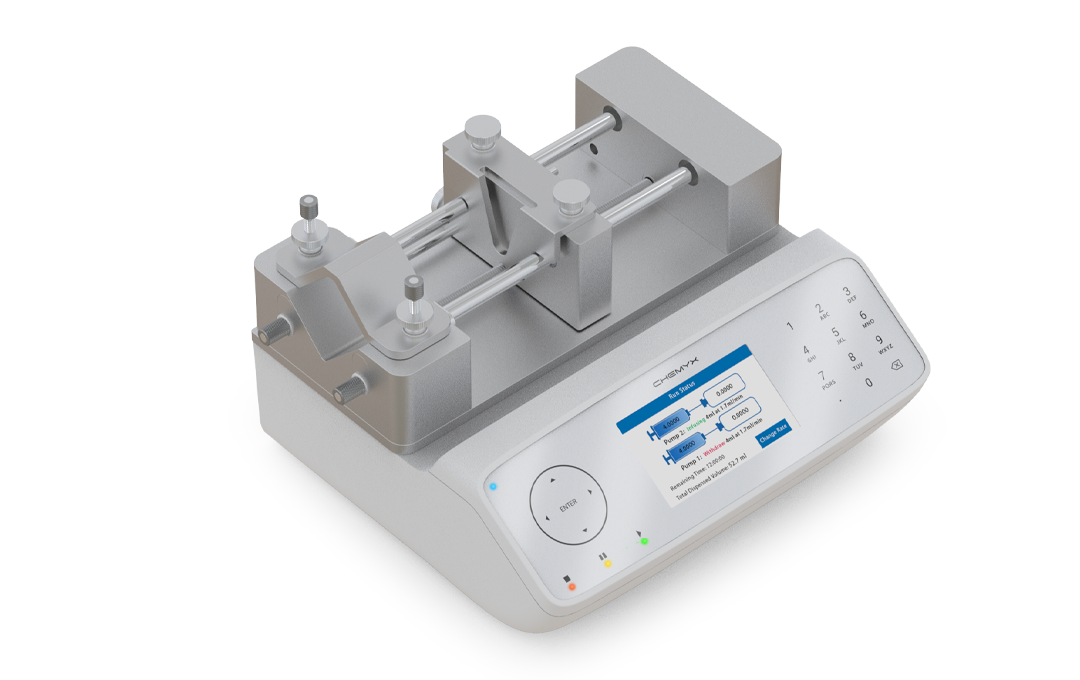
| Heated or viscous material, portable, up to 4,000 psi | Fusion 6000X | 700 lb of force, heating sleeve to 80°C, pressure sensor |
Five Questions That Settle the Choice
-
What backpressure will the pump see? Include tubing, fittings, valves and the reactor or column, not just the vessel pressure.
-
What flow rate, and for how long? Run time times flow rate gives the volume per run.
-
Can the process pause while the pump refills? If not, you need continuous flow from the HP6-CF.
-
What is the fluid? Identity, concentration, viscosity and temperature decide cylinder and seal materials.
-
How will you control it? Front panel, PC software, or USB, RS232 and TTL signals from your own system.
When backpressure exceeds about 4,000 psi or a run needs more than 400 mL per fill, the HP6 is the Chemyx pump built for the job.
How Cylinder Size Sets Pressure and Flow on the HP6
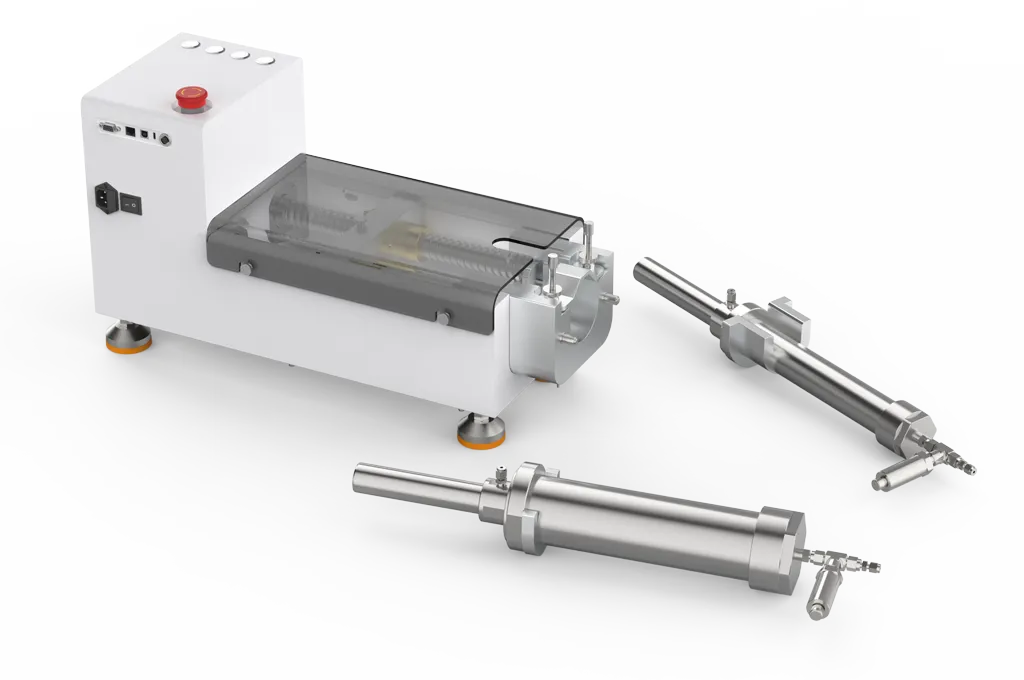
On the HP6, a smaller cylinder gives more pressure and a larger cylinder gives more flow and volume. The same 6 to 10 tons of drive force acts on a smaller or larger piston. Pressure equals force divided by piston area, so halving the area roughly doubles the pressure. A larger piston moves more fluid per millimetre of travel, so maximum flow and volume per fill rise as pressure falls.
| Cylinder | Maximum Pressure (bar) | Maximum Pressure (psi, approx.) | Maximum Flow (mL/min) |
|---|---|---|---|
| 90 mL | 2,124 | 30,800 | 66 |
| 125 mL | 1,386 | 20,100 | 101 |
| 250 mL | 693 | 10,050 | 205 |
| 500 mL | 379 | 5,500 | 375 |
| 1 L | 193 | 2,800 | 734 |
Source: HP6 specifications.
Worked Example: Sizing a Cylinder
A pilot reactor runs at 1,000 bar and needs 40 mL/min for 2 hours, or 4.8 L in total. Only the 90 mL and 125 mL cylinders reach 1,000 bar. The 125 mL cylinder covers the flow rate but holds about three minutes of delivery. That means dozens of refills per run, which points to the HP6-CF rather than a single pump.
How to Pick a Cylinder
-
Pressure first: Rule out every cylinder whose maximum pressure is below your backpressure plus a safety margin.
-
Then flow: From what remains, rule out cylinders whose maximum flow is below your target.
-
Then volume: Choose the largest remaining cylinder, to minimise refills.
-
Still refilling too often? Move to the HP6-CF.
Most high-pressure syringe pumps have a fixed cylinder, so the pressure–volume trade-off is locked in at purchase. HP6 cylinders are removable and swappable. One pump base can run a 2,000-bar experiment this week and a 1 L charge next week, and a spare cylinder can be cleaned while the other runs. Note that the cylinder rating is not the system rating: tubing, fittings, valves and sensors each need their own pressure rating at or above your operating point.
HP6 or HP6-CF: When Do You Need Continuous Flow?
Choose the HP6-CF when your process cannot pause while the cylinder refills; otherwise a single HP6 is enough. Every single syringe pump eventually runs empty. A single HP6 then withdraws to refill, and delivery stops for that interval. For batch additions, charging a vessel or sampling, that pause does no harm. For a column, a continuous reactor or an extraction, a pause means a pressure drop, a disturbed steady state or a lost run.
| Feature | HP6 (Single Pump) | HP6-CF (Dual Pump, Continuous Flow) |
|---|---|---|
| Delivery | Infuse and withdraw; pauses to refill | Uninterrupted; pistons alternate automatically |
| Pulsation | None during a stroke | None, including across refills |
| Volume per Run | Limited to one cylinder, up to 1 L | Unlimited while supply lasts |
| Pressure | 193 to 2,124 bar, by cylinder | 193 to 2,124 bar, by cylinder |
| Ideal Application | Batch dosing, vessel charging, sampling, reagent shots | HPLC, supercritical fluid extraction, continuous manufacturing, polymer and monomer injection |
A Quick Test
Divide your cylinder volume by your flow rate. That is your run time between refills. If a whole experiment fits inside it, or your process tolerates a pause at that interval, choose the HP6. If not, choose the HP6-CF.
Example: A 250 mL cylinder at 50 mL/min runs for 5 minutes. A 6-hour continuous extraction would need about 72 refills. That is an HP6-CF application.
The HP6-CF keeps the precision of a syringe pump and removes its one limitation, finite volume. Chemyx builds it from two standard HP6 units, so cylinders, seals and servicing are the same as the single pump. Already own an HP6? Ask Chemyx whether it can be paired with a second HP6 and the Continuous Valve System.
Syringe Pump vs Reciprocating Pump for Pulsation-Free Dosing
A syringe pump delivers smooth, pulse-free flow because one piston moves forward at a constant speed; a reciprocating pump pulses because its pistons cycle through check valves. Reciprocating piston pumps are the default for continuous high-pressure delivery, as in most HPLC systems, and run indefinitely from a reservoir. The cost is pulsation: flow and pressure ripple with each stroke, so these pumps rely on dampers, multiple heads and check valves. Those parts can struggle with liquefied gases, compressible fluids and very low flow rates.
| Feature | Reciprocating Piston Pump | Single Syringe Pump (HP6) | Dual Syringe Pump (HP6-CF) |
|---|---|---|---|
| Flow Smoothness | Pulsed; needs damping | No pulsation during a stroke | No pulsation, including across refills |
| Continuous Delivery | Yes | No; pauses to refill | Yes |
| Liquefied Gases and Compressible Fluids | Check valves can be troublesome | Well suited; fluid is metered by displacement | Well suited |
| Very Low Flow at High Pressure | Harder to keep steady | Strong | Strong |
When Pulsation Matters
Pulsation matters wherever flow or pressure must stay constant at the point of use, such as column chromatography, polymer or monomer injection, supercritical fluid extraction and continuous reactors. In these, a pressure ripple becomes noise in the data or a defect in the product. Chemyx describes the HP6-CF as the preferred choice for HPLC, supercritical fluid extraction and polymer or monomer injection that requires zero pulsation. Continuous performance depends on the valve set, tubing and fittings as well as the pumps, so share your full fluid path with Chemyx when requesting a quote.
Constant Flow, Constant Pressure or Continuous Flow: Which Mode?
Constant flow fixes the rate and lets pressure follow; constant pressure fixes the pressure and lets the rate follow; continuous flow removes refill pauses. Decide which variable your process must hold steady, then pick the configuration.
| Mode | What the Pump Holds Steady | Typical Use | Chemyx Configuration |
|---|---|---|---|
| Constant Flow | Flow rate | Reagent addition, dosing, injection | HP6 or HP6-CF |
| Infuse and Withdraw | Rate in either direction | Charging, sampling, aspiration, repeat cycles | HP6 |
| Continuous Flow | Flow rate, with no refill pause | Chromatography, extraction, continuous reactors | HP6-CF (two HP6 plus the Continuous Valve System) |
| Constant Pressure | Pressure | Core flooding, pressure hold tests, permeability work | Dual-pump HP6; Fusion 6000X with pressure sensor at lower pressures |
| Multi-Step Program | A sequence of rates | Ramps, staged additions | HP1 (programmable multi-step); ask Chemyx for HP6 sequencing |
Constant Flow
The pump moves the piston at a set speed. Pressure rises until it overcomes the resistance of the fluid, tubing and process. This is the default for most dosing and the mode in which syringe pumps are most accurate.
Constant Pressure
The pump reads a pressure signal and adjusts piston speed to hold a set point. Chemyx states that with two pumps the HP6 can run in continuous flow or constant pressure modes. Confirm the sensor, set-point range and control response for your configuration during quoting.
Continuous Flow
Two pistons take turns. While one delivers, the other refills, then the valves switch. The HP6-CF automates this handover.
One HP6 covers constant flow and infuse/withdraw. Adding a second HP6 opens continuous and constant-pressure operation, so a lab can start with one pump and grow into the dual system. The HP6 connects via PC control software, USB, RS232 and TTL; confirm the command set and timing with Chemyx before building it into a PLC or automated rig.
Nitronic 50 or Hastelloy C: Choosing Cylinder Materials
Nitronic 50 is the HP6 standard and suits most process fluids; choose Hastelloy C for aggressive chemistry such as chlorides and strong acids. Either way, confirm compatibility with your actual fluid, temperature and cleaning agents before ordering.
| Wetted Part | Standard | Option |
|---|---|---|
| Cylinder, Piston, Cap | Nitronic 50 | Hastelloy C |
| Seals | Graphite-impregnated PTFE (Teflon) | Contact us |
| HP6-CF Valves | Nitronic | Hastelloy C |
How the Materials Differ
-
Nitronic 50: A nitrogen-strengthened austenitic stainless steel. It is stronger than 316 stainless and resists general corrosion better, which suits high-pressure cylinders handling solvents, hydrocarbons, CO2 and most aqueous media.
-
Hastelloy C: A nickel-chromium-molybdenum alloy chosen for fluids that attack stainless steel, such as chloride solutions, hydrochloric or sulfuric acid, and wet chlorine chemistry.
-
Graphite-impregnated PTFE seals: PTFE is chemically inert to nearly all process fluids. Graphite adds strength and lubricity under high load, and the seals are easy to clean and replace.
Because HP6 cylinders are swappable, you can keep a Nitronic 50 cylinder for routine work and a Hastelloy C cylinder for corrosive runs on the same pump base. Material availability is not a compatibility approval: review every wetted part, including tubing, fittings, valves and sensors, against your fluid. See the Chemyx syringe material compatibility guide.
Delivering Liquefied Gases and Supercritical CO2
A high-pressure syringe pump is one of the most reliable ways to meter liquefied gases because it displaces a known volume rather than relying on check valves. Chemyx notes that fracking and supercritical CO2 research created the need for pumps that deliver liquefied gases reliably and precisely [1].
Liquid CO2, nitrogen and hydrocarbons must stay above their vapour pressure all the way from supply to process. CO2 becomes supercritical above 73.8 bar and 31.1°C, and useful extraction and reservoir conditions often lie well above these values.
Why Syringe Pumps Suit This Job
-
Positive Displacement: The piston sweeps a defined volume, so delivery does not depend on valve seating, which can be unreliable with compressible fluids.
-
Pressure Headroom: With the 90 mL cylinder, the HP6 reaches 2,124 bar, far above the critical pressure of CO2.
-
Low, Steady Flow: Precise stepper-driven motion holds very low flow rates for dosing or co-solvent addition.
Typical Applications
| Application | Recommended System | Why |
|---|---|---|
| Supercritical CO2 Extraction (Batch) | HP6 | High pressure and up to 1 L per fill |
| Continuous Supercritical Fluid Extraction | HP6-CF | Uninterrupted, pulse-free delivery |
| Hydraulic Fracturing and Core-Flood Research | HP6 or HP6-CF | Pressure headroom; constant-pressure mode on dual pumps |
| Pressurised Reagent Addition in Oil and Gas Labs | HP6 | Precise dosing against reactor pressure |
Liquefied gases can need a cooled supply or cylinder to stay liquid during filling. Discuss the fill method, temperature control and pressure relief with Chemyx and review every downstream rating.
Is the HP6 Right for Heated or Viscous Dispensing?
If you need syringe heating and pressures up to about 4,000 psi, the Fusion 6000X is usually the better fit; choose the HP6 when pressure, force or volume goes beyond that.
| Feature | Chemyx Fusion 6000X | Chemyx HP6 |
|---|---|---|
| Linear Force | 700 lb | 6 to 10 tons |
| Maximum Pressure | Up to 4,000 psi (6 mL syringe) | Up to 2,124 bar (about 30,800 psi, 90 mL cylinder) |
| Syringe or Cylinder Volume | 5 to 300 mL stainless steel | 90 mL to 1 L, swappable |
| Max Flow Rate | 408 mL/min | 734 mL/min |
| Heating | Optional sleeve up to 80°C, one syringe | Discuss with Chemyx |
| Pressure Control | Optional pressure sensor holds a user-defined pressure | Constant pressure with dual pumps |
| Viscosity | Up to 250,000 cP | Discuss with Chemyx |
| Format | Portable benchtop, touchscreen | Industrial, PC or serial control |
Why Heat the Syringe?
Many viscous materials thin sharply as they warm. Heating the syringe keeps viscosity steady at the point of metering, so the delivered volume stays consistent through a run. Heating the syringe itself, rather than a reservoir, is best when the material must be at temperature exactly when it is dosed.
When to Move Up to the HP6
-
Pressure: Backpressure exceeds what a 700 lb drive can deliver with your syringe size.
-
Volume: You need more than 300 mL per fill.
-
Fluid: You are working with liquefied gases or supercritical fluids.
-
Continuity: You need continuous delivery from the HP6-CF.
Chemyx High-Pressure Pumps in Published Research
Chemyx high-pressure syringe pumps are cited in peer-reviewed papers and theses spanning ultrahigh-pressure chromatography, liquids at high pressure and drilling fluids. Selected publications:
-
2026: A new capability for investigating the structure and dynamics of liquids at high pressures (Kimmel, Dunlap, Kringle).
-
2025: Improved chromatography and cyclic ion mobility-mass spectrometry for modern pharmaceuticals (Makey, University of Michigan).
-
2024: Preparation of high-efficiency HILIC capillary columns utilizing slurry packing at 2100 bar (Anderson, Hancock, Kennedy, J. Chromatogr. A).
-
2023: Liquid chromatography–mass spectrometry improvements for metabolomics (Anderson, University of Michigan).
-
2022: Dual capillary-based vibrating sharp-edge spray ionization with on-line H/D exchange (Valentine et al.).
-
2016: Application of biomass-derived materials in nanocomposites and drilling fluids (Song).
See the full list on the HP6 product page.
Advance Your High-Pressure Research with the HP6 and HP6-CF
From supercritical CO2 extraction to ultrahigh-pressure chromatography and pilot-plant reagent addition, high-pressure work demands a pump that holds precision where others pulse or stall. The HP6 delivers 6 to 10 tons of force with swappable cylinders from 90 mL to 1 L, and the HP6-CF adds continuous, pulse-free flow for processes that cannot pause.
Chemyx Inc. is committed to supporting this research with pumps engineered for force, flexibility and reliable performance. Request an HP6 quote, request an HP6-CF quote, or explore the full range of Chemyx products. For expert guidance in selecting the right configuration for your application, contact the experienced engineering team today.