

Every core flooding rig depends on two pumps doing very different jobs. One holds overburden pressure around the core, often for days, while barely moving any fluid. The other pushes brine, oil, or CO2 through the rock at a steady rate while you record the pressure drop. Get either one wrong and your permeability numbers drift, your run stops halfway, or your rig simply can’t reach reservoir conditions.
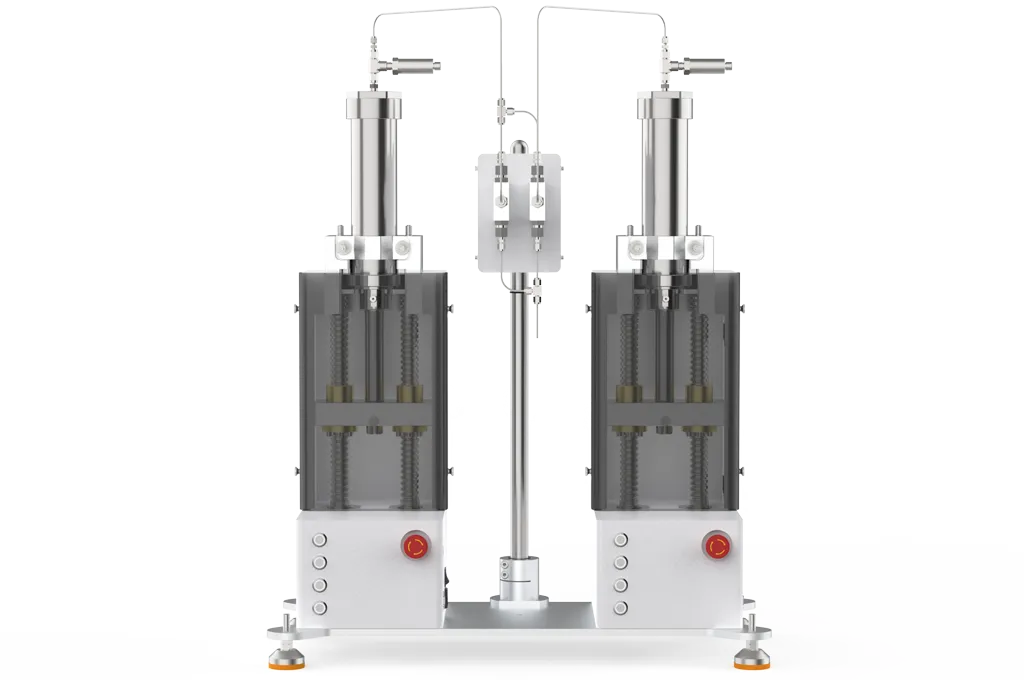
Syringe pumps have long been the standard for both roles because they deliver smooth, pulseless flow. The Chemyx HP6 takes that a step further by covering the full range of core flooding pressures from a single pump base, with swappable cylinders from 90 mL at up to 2,124 bar (about 30,800 psi) to 1 L at 193 bar (about 2,800 psi). Paired as the HP6-CF, two HP6 pumps deliver uninterrupted, pulsation-free flow at up to 20,000 psi.
Here’s how to think through the pump side of a core flooding setup.

Why Core Flooding Is So Sensitive to the Pump
Core flooding pushes fluids through a rock sample under reservoir pressure to measure permeability and see how one fluid displaces another. Petroleum engineers rely on it to screen enhanced oil recovery (EOR) methods, and carbon capture and storage (CCS) researchers use it to study how injected CO2 moves and gets trapped.
In a typical rig, the flow pump sends fluid into a core holder, where the rock sits inside a rubber sleeve. A second pump pressurizes the space around that sleeve to simulate the weight of the rock above the reservoir. A differential pressure transducer reads the pressure drop across the core, and a back-pressure regulator or receiving pump holds the outlet at pore pressure while the effluent is collected and measured.
Permeability comes from Darcy’s law, k = (q × μ × L) / (A × ΔP), which ties the result directly to flow rate (q) and pressure drop (ΔP). That’s the catch. Any pulsation or drift from the pump shows up as noise in the pressure trace and error in the final number. Reciprocating piston pumps, which deliver flow in strokes, are a common source of that ripple. A syringe pump moves its plunger in one continuous motion, so the flow stays smooth even at very low rates.
The Overburden Pump Is About Pressure, Not Volume
The overburden pump has a simple but demanding job: keep the confining pressure above the highest pore pressure in your test, and hold it there. It only has to fill the annulus around the sleeve and make up for small changes as the sleeve and core compress, so it moves very little fluid. What it needs is pressure headroom and the ability to correct itself automatically as temperature or pore pressure shifts over a long run.
To size it, start with the highest pore pressure your protocol reaches, add the net confining stress it calls for, and leave a safety margin on top. The pump’s rating for your chosen cylinder needs to clear that total comfortably.
This is where a small HP6 cylinder makes sense. The 125 mL cylinder is rated to 1,386 bar (about 20,100 psi), enough for deep, high-pressure reservoir simulations with room to spare, and the 90 mL cylinder goes even higher. With two pumps, the HP6 can also run in constant-pressure mode.
The Flow Pump Is Where Volume Catches People Out
For the flow pump, pressure still matters. It has to overcome the back pressure, the pressure drop across the core, and losses in the lines, and that drop climbs quickly with tight rock or viscous fluids. But the number labs most often underestimate is volume.
Core flooding protocols are written in pore volumes, the amount of open space inside the core, and a displacement test often injects dozens of them to reach steady state. Take a standard 1.5 in × 3 in plug at 20% porosity. Its bulk volume is about 86.9 mL, so a single pore volume is around 17.4 mL. Fifty pore volumes works out to 869 mL, which at 0.5 mL/min is roughly 29 hours of continuous pumping.
A single 500 mL cylinder would run dry after about 29 pore volumes. Stopping to refill in the middle of a test interrupts flow, disturbs the pressure profile, and can throw out a steady-state measurement you’ve spent a day building.
The answer is continuous flow from two syringes working in turn: one delivers while the other refills, then they swap. That’s exactly what the HP6-CF does. It pairs two HP6 pumps with an automated, synchronized valve set that alternates between pistons during refill, so the stream into your core never stops or pulses. Dual-pump operation delivers that continuous flow from as low as 0.00001 mL/min at up to 20,000 psi, which makes multi-day floods practical without anyone babysitting the rig.
One Pump Base, Five Pressure Ranges
The HP6 applies the same 6 to 10 tons of force to every cylinder, so the smaller the bore, the higher the pressure it can reach. Larger cylinders trade some of that pressure for more volume and faster flow. Instead of buying a new pump for each test, you swap the cylinder. All Chemyx figures below come from the HP6 product pages [1] [2].
| Cylinder | Max pressure | Flow range | Typical role |
|---|---|---|---|
| 90 mL | 2,124 bar (about 30,800 psi) | 0.1 µL/min to 66 mL/min | Ultra-high-pressure overburden |
| 125 mL | 1,386 bar (about 20,100 psi) | 0.15 µL/min to 101 mL/min | Overburden and high-pressure flow tests |
| 250 mL | 693 bar (about 10,050 psi) | 0.31 µL/min to 205 mL/min | Flow pump for most reservoir pressures |
| 500 mL | 379 bar (about 5,500 psi) | 0.57 µL/min to 375 mL/min | Long, moderate-pressure floods |
| 1 L | 193 bar (about 2,800 psi) | Up to 734 mL/min | High-volume, low-pressure injection |
For more on how syringe size affects pressure, see the high-pressure syringe pump guide.
Choosing Materials for Brine, Crude, and CO2
The fluids in a core flood are rarely gentle, so it pays to choose the cylinder material for the harshest fluid you’ll run, not the most common one. Formation brine is the everyday case, and its chlorides slowly attack metal over long runs. Nitronic 50 handles standard brines well, while Hastelloy C276 is the safer choice for high-salinity or hot brine, acids, and sour fluids containing H2S. The HP6 offers both, along with graphite-impregnated PTFE seals built for chemical resistance.
Crude oil and other viscous fluids ask for force more than anything else, especially at low flow rates through tight rock. If the pressure drop is high, a smaller cylinder gives you more pressure to work with. Polymer and surfactant slugs bring their own sensitivity to shear, which is another reason the steady, pulseless motion of a syringe pump helps.
CO2 deserves its own mention. It becomes supercritical above 31.1°C and 73.8 bar (about 1,071 psi), and it compresses far more than brine does. That means the pump has to bring it up to pressure before injection and then refill without letting system pressure sag. A dual-pump setup in constant-pressure mode handles this well, and controlling the temperature around the cylinder keeps the CO2 in the phase you want.
How the HP6 Compares With Fixed-Cylinder Pumps
Many core flooding rigs were built around fixed-cylinder syringe pumps, where every pressure and volume combination is a separate pump module. A lab that needs 20,000 psi for overburden and a large-volume, lower-pressure flood for injection ends up buying and maintaining several pumps. The HP6 reaches those same points from one base, and at comparable cylinder sizes it offers more volume or more flow. The fixed-cylinder figures below are typical of high-pressure syringe pump modules on the market as of October 2026.
| Pump | Cylinder | Max pressure | Max flow |
|---|---|---|---|
| Chemyx HP6 (125 mL cylinder) | 125 mL | About 20,100 psi | 101 mL/min |
| Typical fixed-cylinder module | 68 mL | 20,000 psi | 25 mL/min |
| Chemyx HP6 (250 mL cylinder) | 250 mL | About 10,050 psi | 205 mL/min |
| Typical fixed-cylinder module | 266 mL | 9,500 psi | 107 mL/min |
| Chemyx HP6 (500 mL cylinder) | 500 mL | About 5,500 psi | 375 mL/min |
| Typical fixed-cylinder module | 500 mL | 5,000 psi | 204 mL/min |
| Older fixed-cylinder module | 500 mL | 3,750 psi | Varies |
In practice, that means one pump can serve several kinds of tests, fill and flush cycles go faster, and labs running older 3,750 psi rigs gain a clear upgrade path: a 500 mL HP6 cylinder lifts the pressure ceiling from 3,750 psi to about 5,500 psi at the same volume. Fixed-cylinder systems still suit some labs, such as those that need certified hazardous-location equipment, so it’s worth raising your site requirements early.
Talk to Chemyx About Your Core Flooding Setup
Every core flooding protocol is a little different, and the right pump depends on your pressures, your core dimensions, the fluids you’re running, and how long each test needs to go. Send us those details, along with how you control the rig today, whether by RS232, USB, TTL, or PC software, and our Houston-based engineers will recommend an HP6 or HP6-CF configuration and cylinder set that fits. You can also browse the available computer control programs.
Request an HP6 quote, request an HP6-CF quote, or explore the full range of Chemyx syringe pumps. For help with a specific application, contact the Chemyx engineering team.