

If you’re asking whether a high-pressure syringe pump will hold up to your process fluid, the honest answer is that the pump is only part of the question. What you really need to know is whether every material your fluid touches can handle it, at your concentration, your temperature, and your pressure.
The short version: document your fluid and operating conditions, list every part in the fluid path, pin down the exact materials, and test anything you can’t confirm on paper. Here’s how to do that well.
What “Wetted” Really Means
Wetted materials are anything that contacts the process fluid. That’s not just the syringe or cylinder. It includes seals, valve seats, tubing, sensors, fittings, and connectors. Industry wetted-material guidance treats the fluid, connectors, materials, temperature, and pressure as one system, and that’s the right way to think about it [1]. A perfectly compatible syringe won’t save you if the O-ring downstream swells.
On a standard Chemyx syringe pump, the fluid stays inside the syringe. The pump itself doesn’t touch it. If something spills, though, it can reach the anodized aluminum or stainless-steel holder and the glass or polycarbonate body of the pump, as noted in the Chemyx pump FAQ. If spills, vapors, or cleaning chemicals could realistically reach those surfaces, check them too.
Know Your Fluid Before You Look at Materials
Start by writing down exactly what’s going through the pump. That means the chemical name, CAS number if you have it, concentration, solvent, pH, additives, dissolved gases, likely contaminants, viscosity, and phase. Your SDS and supplier documents are the best place to pull this from.
Then capture the conditions the fluid will see. Think about the normal and worst-case temperature, maximum backpressure, flow rate, whether you’re infusing or withdrawing, run time, cycle count, and how long fluid sits still in the syringe. Don’t forget what you clean, sterilize, and store with. A material that handles your process fluid can still fail during a hot caustic flush.
The in-between moments matter too: startup and shutdown pressures, temperature swings, priming, and any time concentrated residue might sit in a seal or dead volume. These are easy to overlook and often where trouble starts.
A word on compatibility charts: they’re a good first screen, but they aren’t an approval. Charts are usually built around a pure chemical at a set temperature. Your fluid may be a mixture, run hotter, sit in the syringe for hours, or contain trace additives, and any of those can make it more aggressive than the chart suggests.
When you calculate backpressure, account for the whole flow path. Tubing, fittings, valves, filters, and the reactor or column downstream all add to it, so vessel pressure alone will underestimate what the pump sees. Our high-pressure syringe pump guide covers how pressure, flow rate, run volume, fluid properties, and hardware shape pump and cylinder selection.
Map Every Part the Fluid Touches
Trace the path from the fluid source to the last downstream connection, and give each part its own ID so you can tie test results back to the actual installed item.
Your list will usually include the syringe or cylinder, plunger or piston, seals and O-rings, valves and valve seats, needles and outlets, fittings and adapters, each tubing segment, filters, manifolds, pressure transducers and other sensors, the reactor or column, and any downstream connectors.
Pay close attention to interfaces. Where two parts meet, you often have different materials, finishes, seal shapes, and mechanical loads in one spot. And don’t lump parts together: if three fittings come from different suppliers or use different materials, they get three entries.
Seals and connectors can’t be skipped. Valves and tubing in particular should be chosen together so they meet your system’s volume, flow-rate, pressure, and chemical-compatibility needs [2]. Our research-lab syringe pump guide touches on these wider selection factors as well.
Safety note: A part being chemically compatible doesn’t mean it’s pressure-rated. Before anything goes under pressure, confirm every installed part is rated for it, make sure connection types match, guard the setup, use pressure monitoring, and fully depressurize before inspecting anything. Never pressurize hardware you can’t identify.
Get Exact Material and Seal Specs
“Stainless steel,” “plastic,” “rubber,” and “PTFE seal” aren’t specific enough. Two parts with the same label can behave very differently. For each component, try to record the alloy grade, polymer grade, or elastomer compound, along with any fillers, coatings, plating, adhesives, or surface treatments. Note the manufacturer and part number, and the lot or certificate number if you need traceability.
Ask suppliers for performance data, not just material identity. A seal or valve seat that looks fine after a quick room-temperature check can still swell, wear, or leak after thousands of cycles at your real concentration and temperature.
For the syringe itself, check material, size, and specs in our syringe material compatibility resources. Then confirm with the syringe or material supplier that their chemical-resistance data matches your actual fluid, concentration, temperature, and material grade.
Chemyx pumps are syringe agnostic, so any syringe that fits the holder will work mechanically. Fit tells you nothing about chemical resistance, pressure capacity, temperature limits, or cleanliness, though. Check those separately. If you can’t get exact documentation for a part, mark it unknown rather than guessing from appearance or a catalog description.
Matching Materials to Chemyx High-Pressure Syringe Pumps
At high pressure, a part needs both strength and chemical resistance. Here’s how the Chemyx high-pressure range fits into a compatibility review.
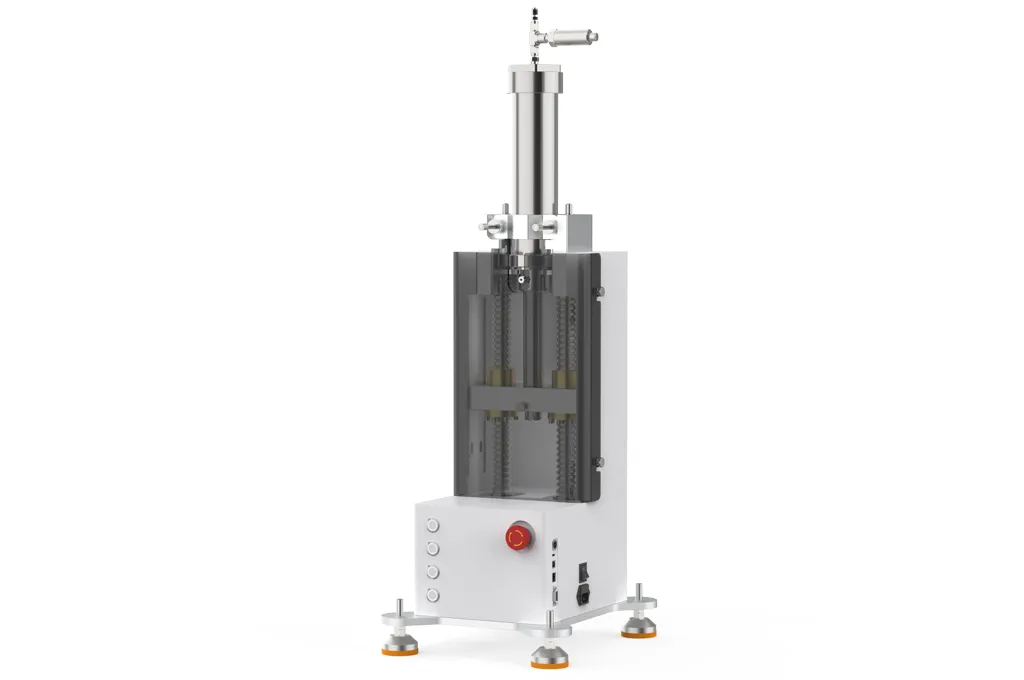
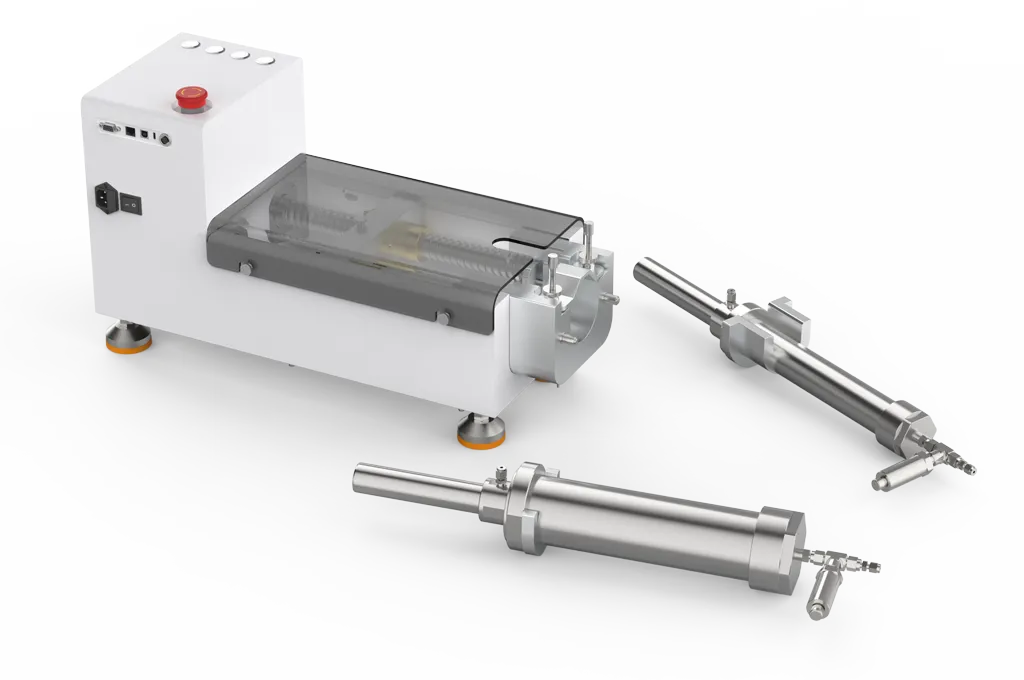
The Chemyx HP6 ultra high-pressure syringe pump delivers 6 to 10 tons of force and reaches up to 2,124 bar with its 90 mL cylinder. Its cylinder, piston, and cap come standard in Nitronic 50, with Hastelloy C available for aggressive chemistry such as chlorides and strong acids. Seals are graphite-impregnated PTFE. Because HP6 cylinders are swappable, you can keep a Nitronic 50 cylinder for routine work and a Hastelloy C cylinder for corrosive runs on the same pump base.
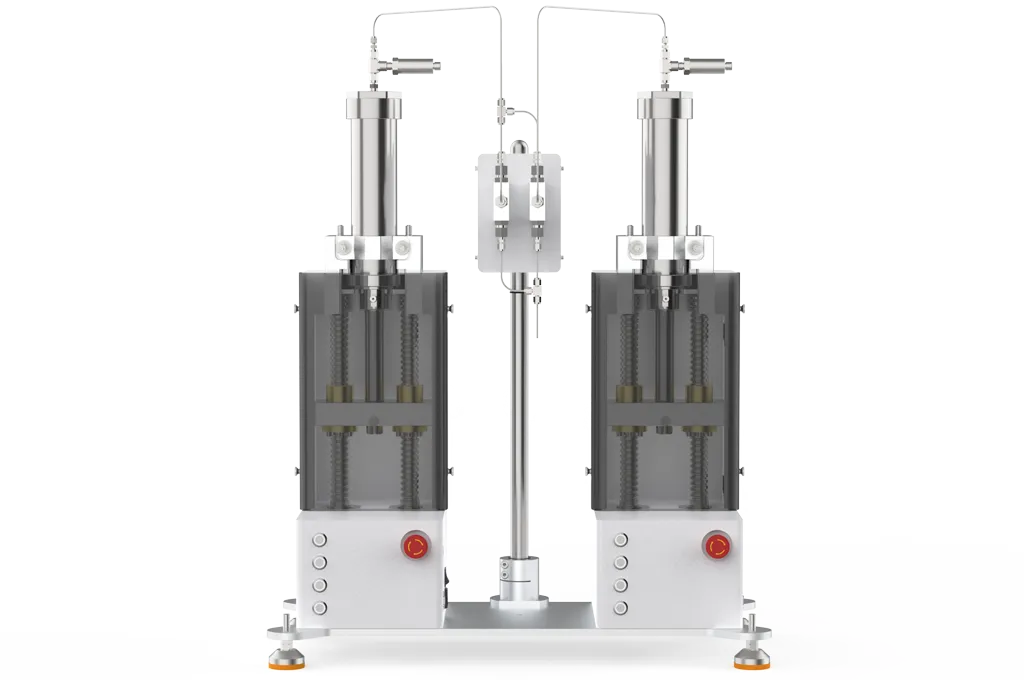
If your process can’t pause while the cylinder refills, the HP6-CF continuous flow syringe pump pairs two HP6 pumps with a synchronized valve set. Its valves are another wetted part to review, and they’re offered in Nitronic or Hastelloy C.
For lower pressures, the Chemyx HP1 high-pressure syringe pump provides 1 ton of force for pressures up to about 3,850 psi with 50 to 400 mL cylinders. If you’re working with heated or viscous material, the Fusion 6000X offers 700 lb of force, up to 4,000 psi with a 6 mL syringe, and an optional heating sleeve up to 80°C.
For syringe materials, Chemyx offers 316 stainless steel syringes, Nitronic syringes, and Hastelloy C syringes for more corrosive service.

Two cautions apply across the whole range. First, material availability isn’t the same as compatibility: you still need to check your exact fluid, temperature, dwell time, and cleaning agents against every wetted part. Second, the cylinder rating isn’t the system rating. Tubing, fittings, valves, and sensors each need their own pressure rating at or above your operating point. For more on how syringe choice, pressure, and accuracy connect, see our precision syringe pump evaluation.
Judge Chemical, Pressure, and Temperature Limits Separately
It’s tempting to give a part a single pass or fail, but a part can pass one requirement and fail another. Look at each on its own:
-
Chemical compatibility: Does the fluid or cleaning agent degrade the material under your conditions?
-
Pressure rating: Can the part and its connections take your system pressure as installed?
-
Temperature rating: Does it keep its properties across process, cleaning, sterilization, and storage temperatures?
-
Fatigue: Will it survive cyclic pressure, piston travel, valve actuation, and repeated assembly?
-
Contamination: Could it shed leachables, extractables, particles, or corrosion products into your fluid?
Failure can show up as corrosion, pitting, swelling, softening, embrittlement, cracking, permeation, seal extrusion, leaks, or dimensional change. Which ones matter depends on your materials and conditions. In regulated or purity-sensitive work, leachables and extractables deserve particular attention.
Never borrow a rating from one manufacturer’s part and apply it to another part with a similar-sounding material name.
When the Data Runs Out
Gaps are risks. If a chart doesn’t list your chemical, the concentration isn’t specified, the fluid is proprietary, or two suppliers disagree, treat the part as unresolved.
Go back to the manufacturer with the full picture: fluid identity, concentration, viscosity, phase, additives, a bill of materials for the fluid path, pressure and temperature range, flow and operating mode, cleaning conditions, run time, and any purity requirements. Fluid identity, concentration, viscosity, and temperature all drive cylinder and seal selection, so “solvent service” or “high-pressure dosing” won’t get you a useful answer.
Escalate early if your application involves aggressive chemicals, high pressure, elevated temperature, long dwell times, mixed or proprietary fluids, harsh cleaning, or regulated production. And don’t close a gap by picking the most favorable entry from unrelated charts. Small differences in grade, compounding, or part design can change the result.
Testing What You Can’t Confirm on Paper
Testing is for closing specific gaps, not for replacing documentation or justifying unrated hardware. Confirm everything in the test setup is pressure-rated before you start.
Decide what you’re testing and set pass and stop criteria up front. Use representative samples, such as production-equivalent parts, seals from the intended compound, or full assemblies when interfaces matter. Record a baseline of mass, dimensions, appearance, hardness, seal condition, leakage, and flow. Then expose the samples to your real fluid and cleaning chemistry at a realistic temperature, including dwell time.
After soaking, compare everything to the baseline. If you need functional evidence, follow up with a guarded, pressure-rated dynamic test and watch for leaks, pressure stability, sealing, and delivery performance. Where it applies, test both individual component function and long-term system performance, as recommended in the Open Compute dielectric-fluid guidelines [3].
Stop safely if you see corrosion, cracking, swelling, softening, leaks, unstable pressure, contamination, or poorer delivery. Isolate the affected parts and keep them for inspection.
Approving the Setup and Managing Changes
Once everything checks out, write up an approval record for that exact configuration. Include the fluid and concentration, operating envelope, full wetted path, part numbers, material and seal specs, the documents you used, test results, remaining risks, and the reviewer’s name and date.
That approval covers that configuration only. Reopen the review if the fluid, concentration, supplier, cleaning chemistry, pressure, temperature, duty cycle, seal compound, syringe or cylinder, tubing, fittings, valves, sensors, or downstream hardware changes. If the approval is conditional, spell out the limits, because anything outside them isn’t approved.
Common Mistakes
Only the syringe was checked. Review the piston, seals, valves, seats, fittings, tubing, filters, sensors, and downstream connections too.
The review relies on a generic material name. Get the exact alloy, polymer grade, elastomer compound, and manufacturer.
Room-temperature chart data was used for a heated process. Get data for your actual temperature range, or treat the part as unresolved.
A pressure rating was treated as proof of chemical resistance. Evaluate the two separately.
Cleaning agents weren’t considered. Add cleaning, sterilization, rinsing, and storage exposure to your fluid profile.
A change to the setup wasn’t recorded. Reopen the review before running the modified system.
Chemical incompatibility between wetted materials and the system fluid is one of the most common early causes of pump failure, which is why the review needs to cover tubing, manifolds, valves, and pumps across the whole circuit [2].
If you see unexplained leaks or unstable pressure, check seals, fittings, valve interfaces, tubing, and connections before blaming the pump drive. If you notice discoloration, particles, swelling, or unexpected flow changes, stop safely, depressurize, keep the fluid and parts, compare against your baseline, and bring the relevant manufacturers into the review. The Chemyx syringe pump troubleshooting guides can also help narrow things down.
A Few Practical Tips
For best accuracy, choose a syringe where your dispensed volume is at least 20–50% of its nominal capacity. Remember that accuracy depends on the whole system, including syringe size, material compatibility, setup, pressure load, and connection integrity.
Be wary of any claim that a material is universally inert or suitable for every high-pressure fluid. Compatibility always depends on a specific material, part, fluid, and set of conditions.
What you end up with is a clear, traceable decision that shows which parts are approved, under what conditions, and what changes would send you back to review. It also gives you confidence that the entire high-pressure fluid path, not just the pump, is ready for accurate, controlled dosing.
Get Help Choosing the Right High-Pressure Setup
Not sure which setup fits your fluid? Send Chemyx your fluid profile, operating envelope, and fluid-path bill of materials, and our engineers can help you choose between the HP1, HP6, and HP6-CF, along with the right cylinder and wetted materials.
Request an HP6 quote, request an HP6-CF quote, or explore the full range of Chemyx products. For expert guidance on material compatibility for your application, contact the experienced engineering team today.