

What is a laboratory syringe pump? A laboratory syringe pump is a motor-driven precision pump that uses one or more syringes to deliver accurate fluid quantities in research environments. It controls flow rate, volume, direction and timing more consistently than manual syringe operation. Choosing one starts with the flow range your method needs, the syringe volume per run, and the pressure the fluid path creates.
For researchers who need precise, pulseless fluid delivery, Chemyx Inc. offers precision benchtop pumps such as the Fusion 4000X, ultra high-pressure systems such as the HP6 and HP6-CF, and bolt-on OEM modules for instrument integration.
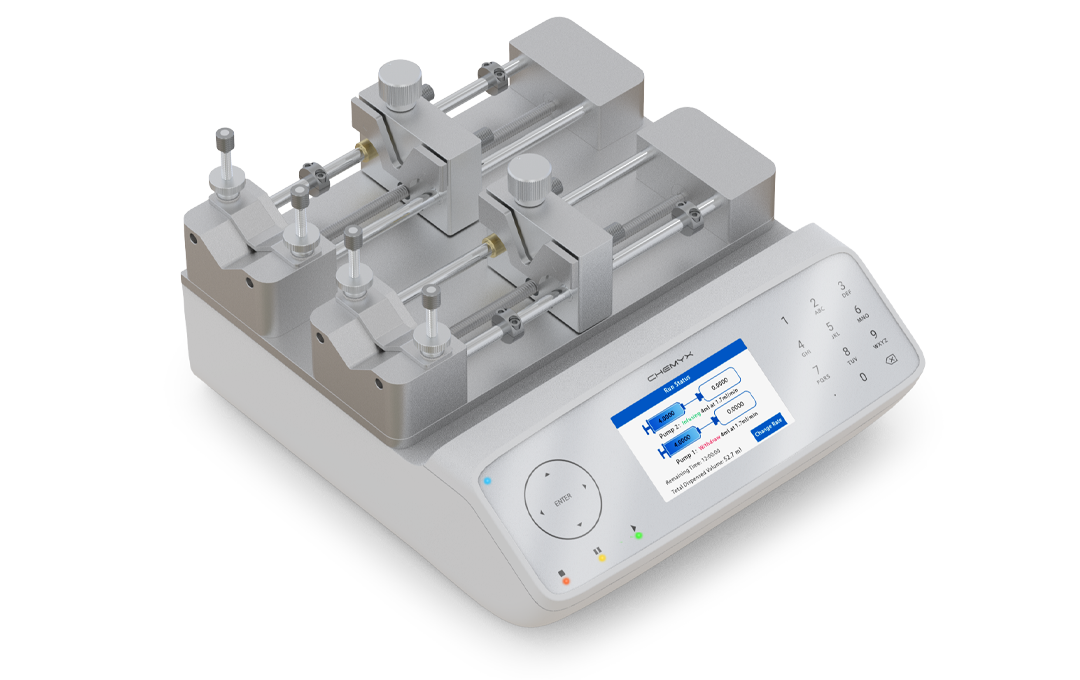
Laboratory Syringe Pumps at a Glance
The working of syringe pump systems centers on controlled plunger displacement. A stepper motor moves a drive platform connected to the plunger while the syringe barrel remains fixed. Advancing the plunger infuses liquid, while retracting it withdraws liquid into the syringe.
Laboratory syringe pumps support controlled, pulseless and reproducible delivery in microfluidics, analytical chemistry, pharmaceutical development and materials research. Common uses include metering reagents, feeding reactors, introducing calibration solutions, controlling samples and automating multi-step dosing.
The main terms differ as follows:
-
Laboratory syringe pump: Uses controlled syringe-plunger displacement for research fluid handling.
-
Infusion pump: Describes a broader fluid-delivery category that includes equipment designed for medical administration.
-
Volumetric pump: Moves fluid through a non-syringe mechanism selected for the required workflow.
-
Syringe driver: Common alternate name for an instrument that drives a syringe plunger.
Laboratory equipment must remain within its stated research or industrial use. A lab syringe pump should not be treated as a clinical infusion device.
How a Syringe Pump Works
A syringe pump converts programmed motor movement into linear plunger motion. The motor drives a plate or pusher block against the plunger, forcing liquid from the fixed syringe barrel.
The Plunger-Drive Sequence
The following labeled sequence is a practical syringe pump block diagram in text form:
-
Syringe setup: Fill the selected syringe and remove unwanted air according to the experimental method.
-
Syringe retention: Place the barrel in the holder and secure it with the syringe clamp.
-
Plunger alignment: Position the plunger interface against the pusher block.
-
Motor actuation: Start the programmed method so the stepper motor turns the drive mechanism.
-
Lead-screw translation: Convert motor rotation into controlled linear movement.
-
Pusher-block motion: Move the platform forward for infusion or backward for withdrawal.
-
Plunger displacement: Change the internal syringe volume at the programmed rate.
-
Fluid transfer: Move liquid through compatible tubing, fittings and the connected experimental device.
-
Method completion: Stop at the programmed volume or reverse direction when the method requires cycling.
Mechanical alignment matters because drive motion must transfer cleanly to the plunger. Secure barrel retention, correct pusher-block contact and a suitable syringe reduce lost motion and setup variability.
Infuse, Withdraw and Continuous-Flow Modes
Infuse mode advances the plunger and dispenses liquid. Withdraw mode retracts the plunger to draw liquid into the syringe, provided the pump, syringe retention system and fluid path support withdrawal.
An automated syringe pump can combine these directions in a programmed sequence. A method might withdraw a reagent, pause, infuse at a controlled rate, change the rate and repeat the cycle. The available commands depend on the pump controller and syringe pump software.
A continuous flow syringe pump coordinates at least two syringes so one delivers while the other refills. The controller alternates their roles and manages valves or fluid-path switching where required. This arrangement avoids the interruption caused when a single syringe reaches the end of its travel.
Flow Rate, Volume and Back Pressure
The pump calculates linear drive speed from the programmed flow rate and the selected syringe dimensions. A smaller syringe produces a different working range from a larger syringe because each unit of plunger travel displaces a different liquid volume.
Available flow and volume depend on the pump model, syringe size, fluid properties, tubing and system resistance. Terms such as micro syringe pump, large syringe pump and 500 mL syringe pump describe desired scale, but they do not establish performance or compatibility. Check the Chemyx syringe library of minimum and maximum flow rates for the range each syringe supports.
Back pressure opposes plunger motion. It can arise from viscous liquids, narrow tubing, restrictive fittings, small channels, filters, reactors, needles or analytical interfaces. Select the drive force, syringe material, connections and pressure accessories for the complete system rather than the pump alone.
Stable low-flow operation is critical in microfluidics because small variations can alter residence time, mixing and device response. A 2024 Lab on a Chip study from the Technical University of Munich tested a Chemyx Fusion 4000 syringe pump with and without lubricated guide rods. Lubrication produced five-fold smoother flow-rate fluctuations, with coefficient-of-variation values below 0.07 [1]. Maintenance condition can therefore affect practical flow stability even when the programmed rate remains unchanged.
Syringe Pump Parts and Their Functions
A syringe pump has three groups of parts: the syringe that holds the liquid, the drive that moves the plunger, and the fluid-path and control components that connect it to the experiment.
Syringe Components
The replaceable syringe assembly holds the liquid and determines how plunger travel translates into delivered volume. It includes the barrel and plunger, plus any tip or connection used to join the syringe to the fluid path.
Syringe function in laboratory work depends on material compatibility, nominal volume, internal diameter, pressure tolerance and physical fit. Glass, plastic and metal syringe designs suit different chemicals and operating conditions; see the syringe type chart for Chemyx pumps. The pump must use the correct diameter setting or syringe selection so its controller can calculate displacement correctly.
A needle is an optional fluid-path termination. Many laboratory systems connect tubing and fittings directly to a reactor, microfluidic chip, vessel or analytical instrument, so a needle is not required.
Pump and Drive Components
The drive assembly creates and controls plunger movement. Its principal parts include the motor, lead screw, pusher block, syringe holder and clamp.
The motor supplies rotary motion, while the lead screw converts that rotation into linear travel. The pusher block transfers the resulting force to the plunger. Precision-machined components, rigid support structures and secure clamps help maintain alignment under changing flow and pressure conditions.
Infuse/withdraw pumps also require a mechanism that retains the plunger during retraction. This arrangement lets the drive pull the plunger backward instead of merely pushing it forward.
Fluid-Path and Control Components
Tubing, fittings, valves and optional needles carry liquid from the syringe to the experiment. Each wetted component must tolerate the solvent, temperature, pressure and cleaning method used in the workflow.
The controller converts a requested flow profile into drive commands. Depending on the pump, users may enter methods through an onboard interface, computer software, serial connection, trigger input or an instrument controller.
Power and communication interfaces connect the pump to its electrical supply and automation environment. See Chemyx compatible power and computer control. OEM systems may expose interfaces intended for integration with analytical instrumentation or a programmable logic controller.
| Component | Function in the System |
|---|---|
| Syringe Barrel | Holds the liquid and remains fixed while the plunger moves |
| Syringe Plunger | Changes the internal syringe volume to infuse or withdraw liquid |
| Plunger Interface or Pusher Block | Transfers linear drive movement to the syringe plunger |
| Syringe Clamp | Retains and aligns the syringe barrel during operation |
| Drive Motor | Generates controlled motion for the delivery method |
| Lead Screw | Converts motor rotation into linear pusher-block travel |
| Tubing | Carries liquid between the syringe and the experiment |
| Fittings | Join the syringe, tubing, valves and connected device |
| Needle | Provides an optional dispensing or introduction endpoint |
| Controller or Software | Programs flow rate, volume, direction, timing and method steps |
| Power Interface | Supplies electrical power to the pump |
| Communication Interface | Connects the pump to software, triggers, PLCs or analytical instruments |
Laboratory Syringe Pump Types and Configurations
Syringe pumps are grouped by how many syringes they drive, whether those drives are independent, and whether they deliver continuously, at high pressure or inside another instrument.
Single-Channel and Dual-Channel Pumps
A single-channel syringe pump controls one fluid path. It suits reagent addition, sample transfer, calibration delivery and other methods that require one independently controlled syringe.
A dual-channel syringe pump holds or drives two syringes. The channels may move together or independently, depending on the model. Independent operation supports two reagents, different rates, paired infuse/withdraw methods or synchronized experimental steps.
The Fusion 4000X has two independent pump drives that operate at individual rates. An add-on push/pull rack expands capacity to four syringes while retaining the two independent drives. This arrangement supports paired delivery, withdrawal and oscillatory profiles.
Multi-Channel and Push-Pull Systems
A multi-channel syringe pump controls several syringes for parallel delivery or more complex dosing. Channel count alone does not establish control capability. Check whether the channels share one drive, use independently programmed drives or operate in grouped banks.
A multi-syringe pump can feed parallel reactors, dose several samples or supply different streams to one experimental platform. A double syringe pump may simply move two syringes together, while a dual-independent model can assign a separate rate and direction to each drive.
Push-pull operation coordinates syringe movement in opposite or alternating directions. The Fusion 4000X uses continuous cycle mode to alternate its two channels in push-pull operation for non-stop flow.
Continuous-Flow, Portable, High-Pressure and OEM Pumps
Continuous-flow systems coordinate delivery, refill and fluid-path switching. The HP6-CF combines two HP6 systems with an automated synchronized valve set to maintain uninterrupted, pulsation-free delivery during refill cycles. For sizing and mode selection, see our complete guide to the HP6 and HP6-CF high-pressure syringe pumps.
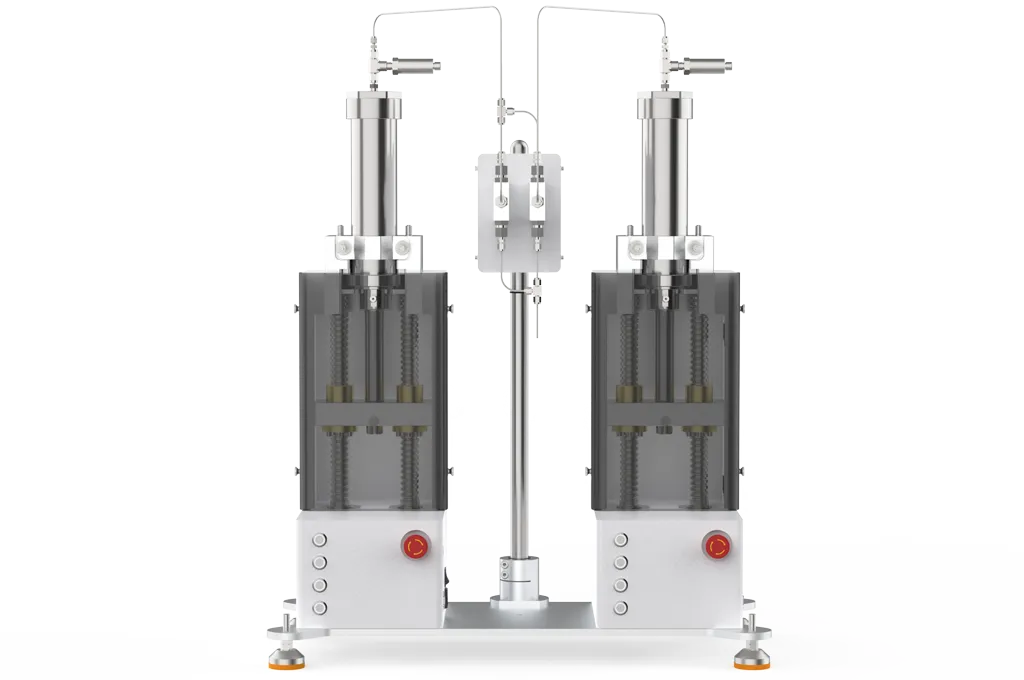
A portable syringe pump prioritizes a compact format for transportable experiments or constrained equipment layouts. Portability does not define flow, pressure, battery operation or clinical suitability, so verify each requirement from the model specification.
A portable high-pressure configuration addresses viscous fluids and resistant systems where greater drive force is required. High-pressure syringe pump systems also need suitable syringe cylinders, seals, valves, tubing and fittings, such as stainless steel syringes and high-pressure fittings. Chemyx high-pressure options include the Fusion 6000X, HP1 and HP6.
An OEM syringe pump is designed for installation within another instrument. Chemyx offers three bolt-on OEM modules for analytical-instrument integration: the SKE 70 microfluidic module, the Fusion 4000X OEM with dual independent channels, and the Fusion 6000X OEM for high-pressure work. The Fusion 4000X OEM carries the same specifications as the benchtop Fusion 4000X.
| Configuration | Channel and Delivery Approach | Flow Rate and Precision Considerations | Pressure and Syringe Considerations | Typical Laboratory Application |
|---|---|---|---|---|
| Single-Channel | One syringe and one controlled fluid path | Model- and syringe-dependent | Match syringe size, material and resistance | Reagent addition, sample transfer, calibration |
| Dual-Channel | Two grouped or independent delivery paths | Verify whether rates and directions are independently controlled | Confirm syringe capacity and shared or separate drive force | Paired dosing, mixing, infuse/withdraw workflows |
| Multi-Channel | Several syringes operated in parallel or by multiple drives | Channel architecture affects rate independence | Confirm rack capacity, syringe fit and total load | Parallel experiments and multi-reagent dosing |
| Continuous-Flow | Alternating delivery and refill, usually with paired syringes | Transition control affects flow continuity | Requires compatible valves and refill path | Uninterrupted flow chemistry or analytical delivery |
| Portable High-Pressure | Compact pump configured for resistant fluid paths | No category-wide range established | Verify force, pressure-rated cylinders, fittings and seals | Viscous fluids and high-resistance systems |
| OEM | Single- or dual-channel bolt-on module | Varies by module; the Fusion 4000X OEM matches the benchtop Fusion 4000X | Varies by module; the Fusion 6000X OEM is the high-pressure option | Analytical-instrument integration |
| Medical/Infusion | Patient-focused fluid administration architecture | Defined by the clinical device and intended use | Requires equipment suitable for the care setting | Controlled administration of drugs, nutrients or blood |
Laboratory Syringe Pumps Versus Infusion, Volumetric and Syringe-Driver Systems
The difference between these systems begins with intended use and delivery mechanism, not with the name on the product.
Laboratory Syringe Pump Versus Medical Infusion Pump
A syringe pump and an infusion pump are not interchangeable terms across laboratory and medical settings. Laboratory pumps support research processes, while medical infusion pumps deliver controlled quantities of nutrients, drugs or blood to patients.
Laboratory pumps may support infuse/withdraw movement, multiple syringes, programmable profiles, nanoliter-scale precision and pulseless flow. A medical pump follows different design priorities and addresses clinical hazards associated with patient administration.
Laboratory syringe pumps must not be represented or used as clinical infusion devices. Clinical administration requires equipment, procedures and approvals appropriate to the care setting.
Searches such as infusion pump syringe pump, infusion and syringe pump, IV syringe pump and syringe infusion pump often mix the two contexts. Procurement teams should begin with intended use and documented device specifications rather than terminology.
Syringe Pump Versus Volumetric Pump
A syringe pump moves fluid by controlling displacement of a plunger inside a syringe. A volumetric pump uses another pumping mechanism selected for the workflow’s delivery, reservoir, pressure and operating requirements.
The volumetric pump vs syringe pump decision depends on required volume, flow stability, refill strategy, fluid compatibility, allowable pulsation and integration needs. Syringe pumps deliver a finite syringe volume unless a continuous-flow arrangement coordinates multiple syringes.
A volumetric syringe pump is therefore an ambiguous search term. Confirm whether the requirement is syringe-based positive displacement or a non-syringe volumetric mechanism.
Syringe Pump Versus Syringe Driver
Syringe driver commonly describes the same general plunger-driving instrument category. In laboratory contexts, both terms can refer to an electromechanical system that infuses or withdraws liquid by moving a syringe plunger.
Naming alone does not establish intended use. For any syringe driver vs infusion pump comparison, verify the application, operating modes, syringe compatibility, software functions, pressure capability and clinical or laboratory designation.
| System Type | Fluid-Delivery Mechanism | Primary Context | Key Selection Consideration |
|---|---|---|---|
| Laboratory Syringe Pump | Motor-controlled syringe-plunger displacement | Research, analytical, industrial and instrument-integration workflows | Flow range, syringe size, pressure, direction, channels and programming |
| Medical Infusion Pump | Clinical fluid-delivery mechanism, which may use a syringe or another reservoir | Patient administration | Intended use, clinical procedures, hazards and applicable approvals |
| Volumetric Pump | Non-syringe pumping mechanism | Laboratory, process or medical contexts depending on the device | Reservoir format, delivery mechanism, fluid path and operating requirements |
| Syringe Driver | Motor-controlled syringe-plunger displacement | Meaning depends on product and context | Verify specifications and intended use rather than relying on the name |
Laboratory Uses and Advantages
Laboratory syringe pumps are used wherever a method depends on small, steady and repeatable liquid delivery.
Microfluidics and Flow Chemistry
Microfluidic systems require controlled delivery through small channels. A laboratory syringe pump can meter micro- and nanoscale quantities, add trace chemicals over an experiment and maintain a low flow rate for device testing.
Stable delivery supports repeatable residence time, droplet formation, gradients, mixing ratios and reaction conditions. The practical advantages depend on syringe geometry, drive condition, tubing compliance and resistance within the microfluidic device.
Flow chemistry may require continuous reactant addition, controlled stoichiometry, sampling or staged rate changes. Independent channels let researchers alter separate streams without replacing the complete pumping system.
Analytical Chemistry and Mass Spectrometry
Analytical methods use syringe pumps for sample introduction, standard addition, calibration delivery and controlled reagent dosing. Precise delivery reduces fluid-handling variation at the point where a sample enters an instrument or preparation workflow.
Pulseless flow matters in sensitive chromatography and mass-spectrometry applications because flow fluctuations can introduce noise and compromise results. Pump selection must account for the method’s rate range, solvent compatibility, fittings, pressure and required duration.
A precision dosing pump can also support dilution, derivatization, titration and controlled transfer. Automation improves repeatability when the method requires the same rate profile across many runs. Browse the Chemyx application reference library for published methods.
Pharmaceutical, Materials and Biological Research
Pharmaceutical development uses syringe pumps for formulation work, controlled reagent addition, dissolution-related experiments and small-volume process studies. The pump must suit the formulation’s viscosity, chemical composition and required pressure.
Materials researchers use controlled delivery in polymer processing, electrospinning, coating, aerosol generation, nanoparticle synthesis and reaction studies. A high-pressure or heated arrangement may be needed for viscous solutions and temperature-sensitive flow behavior.
Biological research applications include perfusion, controlled media addition, sampling, organ or tissue studies and delivery into research devices. In each case the pump converts a defined method into repeatable liquid movement without implying clinical suitability.
Syringe Pumps in HPLC, LC-MS and ESI-MS Workflows
A syringe pump in HPLC, LC-MS or HPLC-ESI-MS setups provides a controlled source for direct infusion, calibration solution delivery or reagent addition. It does not replace every chromatographic pumping function.
Where the Pump Fits in the Workflow
A typical labeled workflow is:
-
Reservoir syringe: Holds the sample, standard or reagent.
-
Pump drive: Advances or retracts the plunger at the programmed rate.
-
Tubing and fittings: Carry the liquid through a compatible, pressure-suitable path.
-
Introduction point: Connects the delivered liquid to the sample line, calibration route or reagent inlet.
-
Ion source or analytical interface: Receives the controlled stream for measurement.
-
Data acquisition: Records the instrument response against time and method conditions.
The exact arrangement depends on the analytical instrument and method. Verify whether the pump introduces liquid directly, joins an existing mobile phase, supplies a post-column reagent or feeds a separate calibration interface.
Direct Infusion, Calibration and Controlled Reagent Delivery
Direct infusion sends a sample or standard to an ion source without relying on a chromatographic separation step at that point. A syringe pump provides controlled delivery for tuning, source evaluation, method development and stable sample introduction.
Calibration workflows can use the pump to deliver a standard at a defined rate. Controlled reagent addition also supports post-column chemistry, internal-standard introduction, derivatization or other method-specific functions.
Syringe pumps can minimize fluid-delivery errors in mass spectrometry, HPLC and LC-MS workflows. The instrument method still governs the final connection, timing, solvent and acceptable pressure.
Flow Stability and Setup Considerations
Pump position and height relative to the infusion line can affect flow accuracy at low rates. Hydrostatic pressure, tubing compliance, trapped gas, connection dead volume and line resistance can influence the flow that reaches the analytical interface.
Use rigid, chemically compatible connections where the method requires them. Prime the path, remove unwanted bubbles, confirm the correct direction and allow the system to stabilize before collecting critical data.
Verify the final flow path, fittings, solvent compatibility and pressure requirements against the analytical instrument method. No universal LC-MS flow rate applies to every source, sample or interface.
How to Select a Laboratory Syringe Pump
Flow range, syringe volume and pressure decide the pump class. Channels, programming and material compatibility then narrow the choice.
Match the Flow Rate and Syringe Volume
Start by defining the minimum and maximum flow required by the method. Include startup, steady delivery, refill, cleaning and any programmed rate changes rather than selecting from one nominal operating point.
Choose syringe volume and material next. A large-volume syringe extends run time at a given rate, while a smaller internal diameter can support finer volumetric displacement. The pump must physically retain the syringe and use the correct diameter setting.
For the best accuracy, choose a syringe whose nominal volume is reasonably close to the volume you need to deliver. Syringe manufacturers typically verify accuracy near full scale, so delivering only a small fraction of a large syringe’s capacity makes small-volume dosing less accurate.
Evaluate Accuracy, Reproducibility and Pressure
Accuracy describes how closely the dispensed volume matches the target. Reproducibility, or precision, describes how consistently the system produces the same result across repeated operations.
Evaluate both measures under conditions relevant to the method. Syringe geometry, mechanical condition, calibration, fluid compressibility, temperature, trapped gas, tubing expansion and back pressure can affect delivered flow.
Establish the maximum expected system pressure from fluid viscosity and downstream resistance. Then confirm that the pump, syringe, seals, tubing, fittings, valves and connected equipment suit that condition.
Choose Channels, Programming and Integration
Determine whether the method needs infuse-only operation or both infuse and withdraw. Then define the number of syringes and whether each channel requires an independent rate, direction, start time or endpoint.
Programming requirements may include stepped rates, pauses, loops, gradients, oscillation, triggers or continuous cycling. Confirm whether the method runs from the pump interface, external software, LabVIEW, serial commands or PLC integration. Chemyx publishes its computer control programs for these setups.
OEM integrators should also assess mechanical mounting, power, communication, control ownership, service access and fluid-path replacement. An industrial programmable syringe pump needs interfaces that fit the complete instrument architecture.
Complete the selection by confirming wetted-material compatibility. Review the syringe, plunger seal, tubing, fittings, valves and any needle against the solvent, reagent, temperature and cleaning process. See the Chemyx syringe material compatibility guide.
Compare Chemyx Models by Verified Specifications
The Fusion 4000X provides two independent infuse/withdraw channels. It accepts syringes from 0.5 µL to 100 mL, covers 0.0001 µL/min to 170.5 mL/min, and specifies accuracy of less than ±0.35% with reproducibility of less than ±0.05%.
The HP6 accepts five interchangeable syringe-cylinder sizes: 90 mL, 125 mL, 250 mL, 500 mL and 1 L. Its listed flow range runs from 0.1 µL/min with the 90 mL cylinder to 734 mL/min with the 1 L cylinder, with reproducibility of less than ±0.2%. Operating pressure ranges from 193 bar with the 1 L cylinder to 2,124 bar with the 90 mL cylinder. The HP6-CF is the continuous-flow configuration.
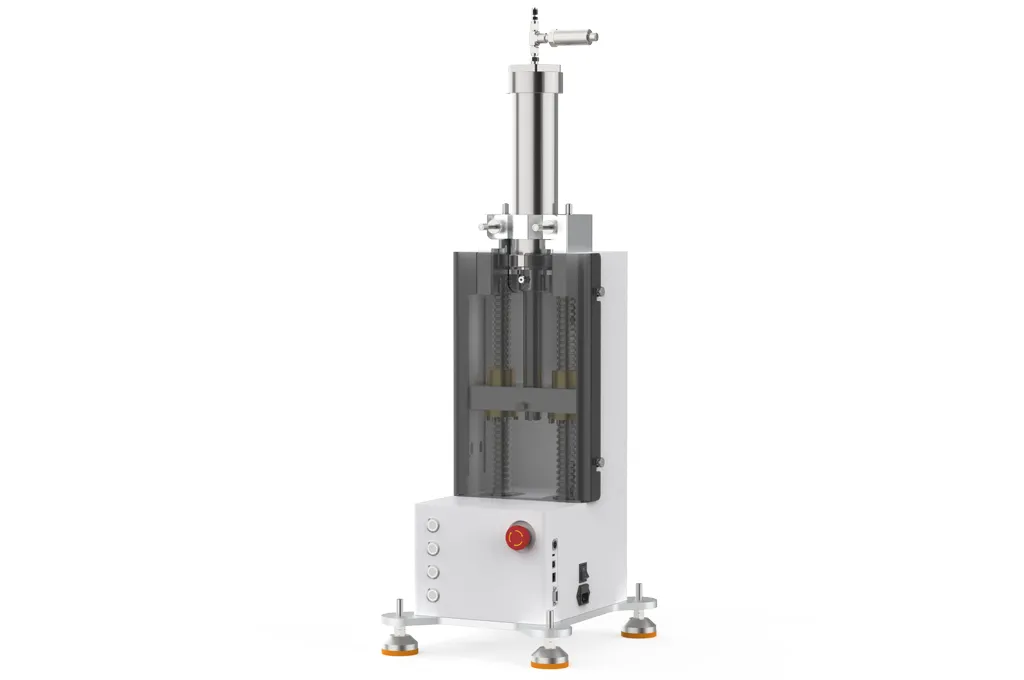
Chemyx OEM modules are bolt-on units for analytical-instrument integration. The Fusion 4000X OEM shares the Fusion 4000X specifications. The SKE 70 and Fusion 6000X OEM have their own specifications, so confirm them from each module’s spec sheet.
| Model or Product Family | Channels and Operating Mode | Syringe Capacity | Flow Range | Accuracy and Reproducibility | Pressure and Primary Role |
|---|---|---|---|---|---|
| Fusion 4000X | Two independent infuse/withdraw drives; expandable to four syringes | 0.5 µL to 100 mL | 0.0001 µL/min to 170.5 mL/min | Accuracy less than ±0.35%; reproducibility less than ±0.05% | Precision multi-syringe dosing and continuous cycling |
| HP6 and HP6-CF | High-pressure system; HP6-CF uses paired systems for continuous flow | Five cylinder sizes from 90 mL to 1 L | 0.1 µL/min (90 mL) to 734 mL/min (1 L) | Reproducibility less than ±0.2% | 193 bar with 1 L cylinder to 2,124 bar with 90 mL cylinder |
| OEM Modules (SKE 70, Fusion 4000X OEM, Fusion 6000X OEM) | Bolt-on single- or dual-channel modules | Varies by module | Varies by module | Fusion 4000X OEM matches the Fusion 4000X | Analytical-instrument integration; Fusion 6000X OEM for high pressure |
Source: Fusion 4000X specifications, HP6 specifications.
Chemyx’s precision benchtop line includes the Fusion 200X, Fusion 4000X and Fusion 6000X. The Fusion 200X is a programmable infuse/withdraw pump, the Fusion 4000X adds dual independent channels, and the Fusion 6000X is built for high pressure with high precision. Similar product names do not indicate equivalent capabilities, so select by verified application requirements. See the difference between the Fusion 4000X and Fusion 6000X.
Accessories, Setup Checks and Terminology
The syringe, fluid path and accessories are part of the dosing system, so they are selected and checked with the same care as the pump.
Syringes, Tubing, Fittings and Needles
Choose a syringe that fits the holder, operating mode, fluid, required volume and expected pressure. Check barrel dimensions, plunger design, connection type and whether withdrawal requires the pump to retain the plunger.
Tubing and fittings form part of the dosing system. Match their internal volume, pressure rating, temperature range and chemical compatibility to the method. Keep connections secure and minimize unnecessary dead volume where it can affect response time or sample use.
Needle selection applies only when the workflow needs a needle. Consider material, connection type, length and internal diameter in relation to the liquid and expected resistance.
Before Operation: Setup Checklist
-
Confirm that the selected syringe fits the pump and method.
-
Secure the barrel and align the plunger interface.
-
Verify that all fittings match and remain leak-free.
-
Check the required flow direction.
-
Prime the fluid path and remove unwanted gas.
-
Assess expected back pressure across the complete system.
-
Confirm the programmed rate, volume, direction and sequence.
-
Inspect tubing placement to prevent kinks or unintended movement.
-
Test the setup under controlled conditions before the experimental run.
If a setup does not behave as expected, see the Chemyx syringe pump troubleshooting guides.
Pressure, Temperature and Expansion Accessories
A pressure sensor lets the system monitor conditions near the syringe or within the fluid path. Its range, wetted materials, location and connection method must suit the experiment.
Heating accessories can warm a syringe when temperature control reduces viscosity or maintains a material in a workable state. Confirm that the syringe, seals, fluid, tubing and nearby hardware tolerate the selected temperature. See Chemyx syringe heaters and pressure sensors.
Expansion racks increase syringe capacity on compatible pumps. They may move several syringes from one drive or expand a push-pull arrangement, so verify whether the added positions remain independently controlled. See Chemyx multi-syringe racks.
Other accessories may include valves, communication cables, footswitches and adapters, trigger interfaces, racks and pressure-related hardware. The Chemyx accessory compatibility chart shows which accessories fit each pump. Accessory names shared with medical equipment do not make a laboratory configuration suitable for patient administration.
Glossary of Syringe-Pump Terms
The following terms help distinguish pump designs from search wording and alternate names. For more definitions, see the Chemyx syringe pump glossary.
-
Syringe infusion pump: A syringe-based pump; intended use must be verified because the term appears in laboratory and medical searches.
-
Infusion syringe pump: Alternate word order for a syringe pump used to infuse liquid.
-
Syringe driver: A device that mechanically moves a syringe plunger.
-
Plunger syringe pump: A descriptive term emphasizing the motor-controlled plunger mechanism.
-
Continuous syringe pump: A coordinated system that alternates delivery and refill to maintain flow.
-
Multi-channel syringe pump: A pump that operates several syringe positions or fluid paths.
-
Dual syringe pump: A system that holds or controls two syringes.
-
Portable syringe pump: A compact or transportable design whose power, pressure and intended use require separate verification.
-
OEM syringe pump: A pump module intended for installation within another instrument.
-
Medical pump: A broad clinical-device term that does not describe a laboratory pump.
-
Syringe dosing pump: A syringe pump configured for controlled reagent or sample dosing.
-
Channel syringe pump: Search wording referring to the number of controlled syringe positions or fluid paths.
-
Needle in syringe: A search phrase for the optional needle attached to a syringe outlet.
Terms such as infusion syringe pump uses and uses of infusion pump may point to clinical information. Laboratory users should qualify searches with research, analytical, industrial, microfluidic or OEM terms to reach the relevant equipment category.
Selection Summary and Expert Support
Select a laboratory syringe pump by defining the application, minimum and maximum flow, syringe capacity, fluid compatibility and expected pressure. Then determine whether the method requires independent channels, infuse/withdraw motion, continuous delivery, programmable profiles or external automation.
Evaluate high-pressure, multi-channel, continuous-flow and OEM requirements against the complete workflow. Model names and maximum specifications do not replace an assessment of syringes, fluid-path components, resistance, software and analytical-instrument interfaces. To see models side by side, compare Chemyx syringe pumps.
Chemyx Inc. is committed to supporting this research with precision, high-pressure and OEM syringe pumps. Request a Fusion 4000X quote, request an HP6 quote, request an HP6-CF quote, or explore the full range of Chemyx products. For expert guidance in selecting the right syringe pump for your application, contact the experienced engineering team today.